


kategória
szerző
cím
sorozat
betöltés...
kiadó
betöltés...
ISBN
évszám
ár
-
leírás
Előrendelhető
A mezők bármelyike illeszkedjen
A mezők mind illeszkedjen



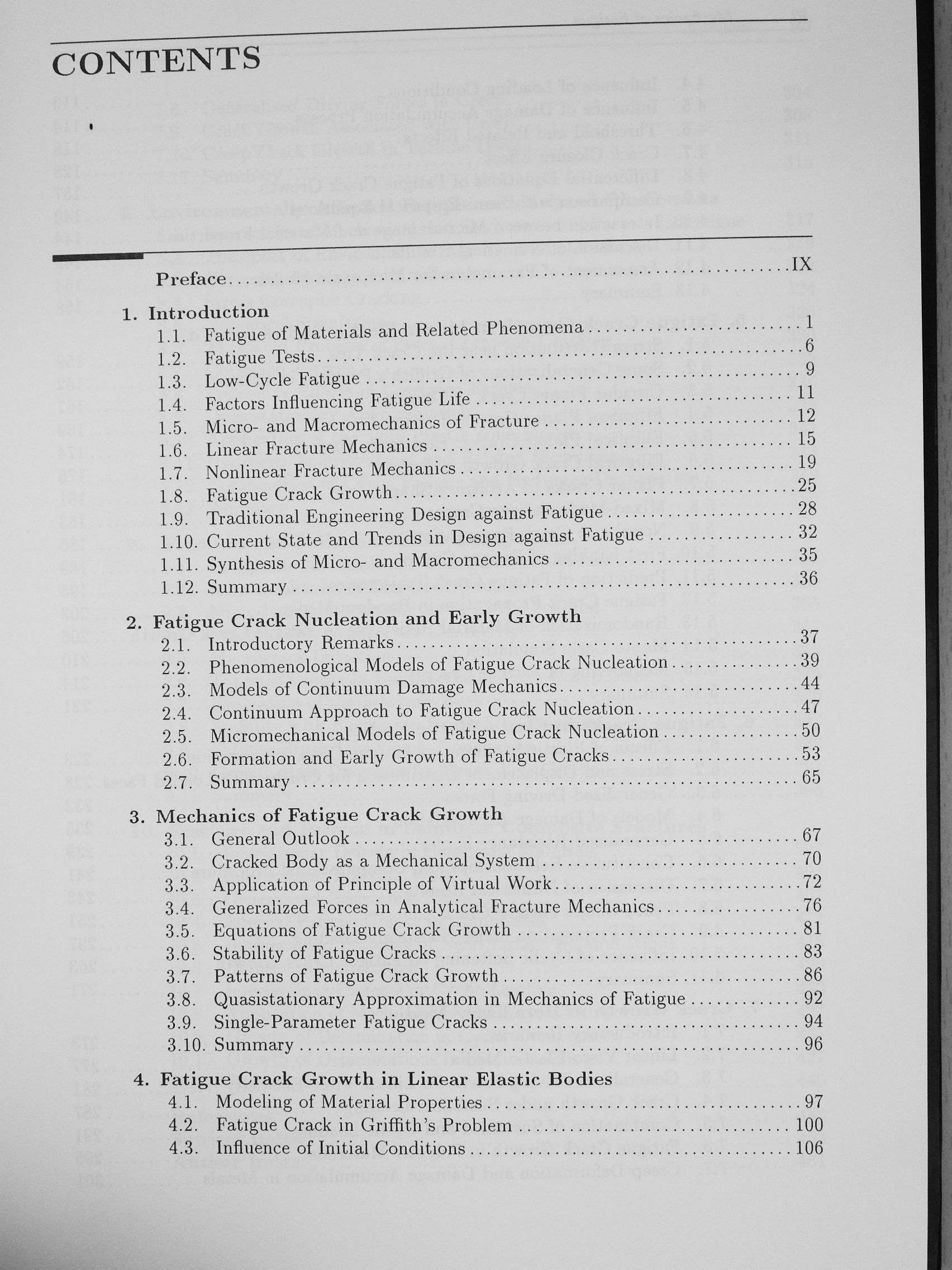

Preface IX
PREFACE
This book is dedicated to the fatigue of materials and structural components of engineering systems. The term fatigue is understood in a broad sense, including crack nucleation and growth up to the final failure under cyclic and/or sustained loads and actions. In addition to the classic high-cycle and low-cycle fatigue, such phenomena as fatigue associated with creep, corrosion fatigue, stress corrosion cracking, etc., are also discussed.
Fatigue and related phenomena are the most frequent causes of failures in...
online ár:
Webáruházunkban a termékek mellett feltüntetett fekete színű online ár csak internetes megrendelés esetén érvényes.
15000 Ft

Részletesen erről a termékről
Bővebb ismertető
Preface IX
PREFACE
This book is dedicated to the fatigue of materials and structural components of engineering systems. The term fatigue is understood in a broad sense, including crack nucleation and growth up to the final failure under cyclic and/or sustained loads and actions. In addition to the classic high-cycle and low-cycle fatigue, such phenomena as fatigue associated with creep, corrosion fatigue, stress corrosion cracking, etc., are also discussed.
Fatigue and related phenomena are the most frequent causes of failures in engineering systems, beginning from minor failures that result in the interruption of operation and the accompanying economic loss up to major accidents with disastrous consequences.
Fatigue is a subject of extensive study by engineers in various branches of industry as well as by researchers in the mechanics of solids and material science. As a complement to already published works, this book discusses the subject in a more theoretical way. Fatigue and all kinds of delayed fracture are considered here from the unified viewpoint of the mechanics of solids and structures. As with other centered positions, this approach cannot be comprehensive. However, it allows deeper insight into fatigue phenomena using the terms and concepts more appropriate for mechanical, civil, naval, and aeronautical engineers. Such an approach develops more detailed planning of fatigue tests, their statistical treatment and interpretation, as well as more efficient use of the known experimental data. In addition, this approach presents new analytical and numerical tools for the analysis of structural safety and reliability, as well as for life-time prediction and other important aspects of an engineer's activities.
The core of this book is built upon the synthesis of micro- and macromechanics of fracture. By micromechanics, the author means both the modeling of mechanical phenomena on the level of material structure (i.e., on the level of grains, fibers, microinclusions, microcracks and micropores) and the continuous approach based on the use of certain internal field parameters characterizing the dispersed micro-damage. This is so-called continuum damage mechanics. As for macromechanics of fracture, the version used here is that developed by the author and called analytical fracture mechanics. This term means that the system cracked body-loading or loading device is considered as a mechanical system, and the tools of analytical (rational) mechanics are applied thoroughly to describe the crack propagation until the final failure.
The book consists often chapters. Chapter 1 is of an introductory character. It contains preliminary information on fatigue and engineering methods for the design of machines and structures against failures caused by fatigue.
Fatigue crack nucleation is the subject of Chapter 2. As this early stage of
Termékadatok
Cím: Mechanics of Fatigue [antikvár]
Szerző:
Vladimir V. Bolotin
Kiadó: CRC Press
Kötés: Fűzött kemény papírkötés
ISBN: 0849396638
Méret: 180 mm x 260 mm
Új vásárló vagyok!
új vásárlóval indíthatsz rendelést............